![]() | ![]() | ![]() | ![]() | ![]() | ![]() | ![]() | ![]() |
![]() | ![]() | ![]() | ![]() | ![]() | ![]() | ![]() | ![]() |
![]() | ![]() | ![]() | ![]() | ![]() | ![]() | ![]() | ![]() |
![]() | |||||||
| By N2H | |||||||
Recent Articles
- Home
- Data Integration Software Options
- Data Integration Solutions
- Database Software Options
- Data Integration Tools
- Disaster Recovery and Business Continuity Auditing
- Disaster Recovery Best Practices
- Disaster Recovery Software Options
- Disaster Recovery Solutions
- High Availability Architecture
- High Availability Solutions
- How to Get Disaster Recovery Certification
- Remote DBA or Database Administration Services
- What is a BLOB or Binary Large Object?
- What are High Availability Clusters
- What are High Availability Servers?
- What Are Disaster Recovery Services
- What is a Data Mart?
- What is a Database Trigger?
- What is a Disaster Recovery Data Center
- What is a Disaster Recovery Plan?
- What is a DSN or Database Source Name?
- What is a Flat File Database?
- What is a Multimedia Database?
- Java Database
- What is a Relational Database?
- What is a Relational Database Management System or RDBMS?
- What is a Stored Procedure?
- What is a Sybase Database?
- What is a Transactional Database?
- What is a Web Database?
What is a Distributed Database?
June 8th, 2009 by Shenron
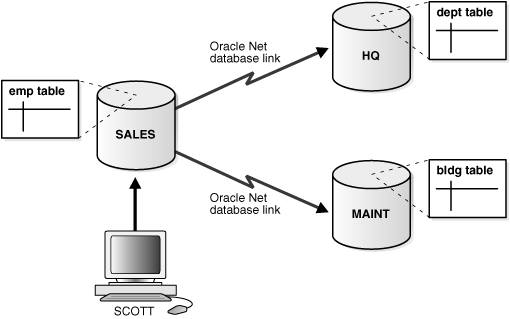
One of the exemplary models of database management systems is the distributed database. Distributed database is the database that is under the command of a central database management system in which certain storage tools are not installed in a single CPU. The distributed database is installed in multiple computers located in the same location or these computers are located in different locations but under interconnected computers. In a distributed database, data are shared through partition fragments, and these fragments can be produced. Moreover, distributed database have proven to be very significant to businesses. With the use of fragmentation and replications, users will be able to secure pertinent data without compromising other applications.
How is Distributed Database Used?
Distributed database is utilized or shared in two ways. Users can use them in local applications or in global applications. When users are utilizing local applications, the database will not require any information or data from other sites. On the other hand, users who are using the global applications will require information from other sites.
When using the distributed database, users must provide utmost care to ensure transparency of transaction and distribution. Whenever distribution across databases is used, users must have the opportunity to view and access these important data. Moreover, each transaction must have transparency across databases.

Advantages and Disadvantages of Distributed Database
Distributed database have provided significant benefits to its users, but nonetheless, it also has its drawbacks that the user has to consider.
Here are the advantages of distributed database:
- Shows organizational structure of data. With the use of the distributed database, users will have access to database fragments, which are essentially located in one central database.
- Independent function. By using the distributed database, users are allowed to segregate common data and manipulate them without compromising the other applications.
- Great availability. The users will be allowed to manipulate other parts of the system if in case a certain portion of the system declines it. A problem in one database will not affect the entire database, but only a fragment of it.
- High-quality performance. With the use of the distributed database, extraction, manipulation as well as storage will definitely be more effective and more efficient. Moreover, users will have the convenience of locating and retrieving the data form the greatest part of the system. Distributed database will create the balance among data servers.
- Cost-efficient. By using the distributed database, users, especially businessmen, will gain more and experience the best services while, at the same time, spend less. Distributed database is cost-efficient because users can use a network of small computers with only a single database.
Here are the Disadvantages of Distributed Database:
- Complicated. Since the distributed database requires the transparency of data, the database management system will require extra work to strictly follow this rule. Because of the number of small computers to be maintained, the database system will need extra work and energy.
- Security. Since other remote sites are not centralized, data fragments are at risk for fraud. That’s why data fragments as well as remote sites should be secured appropriately.
- Lack of values. There are still insufficient tools available in the market to convert a central database system to a distributed database.
Related Posts:
Posted in Architecture, Performance | | 0 Comments
What are Database Indexes?
April 10th, 2009 by Shenron
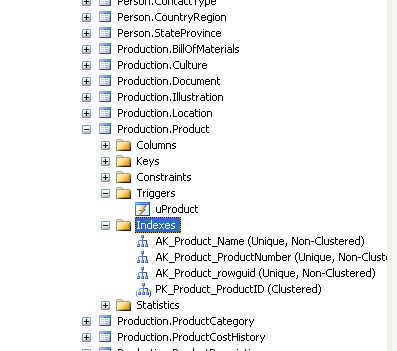
The database index is defined as a database structure whose primary function is to make the operations on a database table faster. Creating a database index requires one or a number of columns on a table for faster accessing of records in a database.
Database indexes only occupy a small part of the disk memory since they only contain important key fields and discard the other fields within the table. This way, the index can be stored even though the database holds a large number of data. Index can also be defined as either non-unique or unique, where unique index functions as a table constraint where it stops replication of rows in an index.
Database Indexes
When it comes to relational databases, the index is considered to be a part of table of the database. The power of the database index is sometimes extended by the other types of databases through creating them within functions or expressions in coding. An example of this is upper (first_name) where the index will only store entries whose first name is in the upper case. Filtered index is another option that is used in databases. The function of the filtered index is to include the data if and only if it passes a criteria designated by the administrator.

Simply put, the index sorts data using key fields or values. Another description of a database index is that it refers to a key value in the right field of the table and is capable of retrieving data in a fast way as long as you know the right search arguments.
Using Database Indexes
To make the most out of the database index here are some tips that you can follow. First is to use a unique element in the index first. Make sure that the element that you will be using has the highest or largest value. This will help you find the page that you are looking for in a faster way. Make sure that the index that you will be creating is small. This will enable you to find pages faster, unlike having a large index. Large indexes can be used for those whose functions are of frequent use. For those who are using small tables, it is better for you not to use indexes as this will only slow down the searching process. It is better to allow the database search all of its record, rather than using indexes. Take note that database index slows down any operations done to the database. This includes deleting or adding data in the database. This is because, once you alter a record in the database, the index also needs to be updated. The index that you will be creating should be a key value that is not updated all the time. This will help your database retrieve data faster.
Types of Database Indexes
There are four types of database index, and these are bitmap index, dense index, sparse index and covering index. In bitmap index, most of the data is stored by bulk in bitmap format. Dense index is a file containing a pair of key and pointer for each record it has in a file. Sparse index is almost the same as the dense index, but it uses keys and pointers for each block in a data file.
Related Posts:
Posted in Architecture, Performance | | 0 Comments
Database Optimization
January 11th, 2009 by Shenron
In the fast-paced world of the internet, you need to keep yourself updated, so it’s important to keep your database maintained to make sure that your system performs well. In the World Wide Web, there are about hundreds of competitors, so it’s important to keep your website in top shape. Apart from database management, web owners should also use database optimization to boost the performance of their systems. Database optimization is becoming more and more of a challenge nowadays, especially when systems software changes constantly. Nonetheless, database administrators are making solutions to keep web owners and their businesses meet the demands of their customers.
Database Administration Softwares
There are different approaches to database administration, and there are also different ways that you can optimize your database to increase its performance, which will also improve your server. The optimization will depend on your database system software. Every database management system software has its own feature for optimization. Even though newer versions are always around the corner, there’s always a program that will enable the system to optimize itself. These softwares are programmed to collect and analyze necessary data, which is used to create decisions for optimization. These programs will be used regularly because more optimization is needed as more implementation is done on the database. Database systems are also getting more and more complex, so it’s important to keep your systems optimized to keep up with the changes in IT.
Indexing Overview
One of the ways in optimizing your database is indexing. This is done to increase the performance of queries. There are some queries that may vary from one another, but generally, all of them benefit from creating efficient indexes. Efficient indexes enable queries to avoid scanning the whole table for results. This method is done with Microsoft SQL servers. The SQL server has a built-in tuning wizard to help establish a set of indexes. It also updates statistical information to enable the optimizer to make optimum decisions in processing queries. Using this information, the wizard will give you suggestions in ways to improve query performance. Keep in mind that you also have to update your database performance analysis, so that you will be able to deal with the changes that occur with dynamic systems. Other systems such as the Oracle have a tuning mode for optimization. This includes an SQL tuning advisor and access advisor. These are used to improved SQL, which is used for packaged applications. It also uses sampling to collect data for optimization.
Optimization is one of the important ways to keep your systems in optimum performance. They may have different names, features and processes, but essentially, they help to increase the performance of your system.
Database optimizers are included in systems softwares which web owners can utilize. These are complex methods which will need an IT professional. Usually, these are daunting tasks, but nowadays, efficient softwares have features that enable optimization to be done much more efficiently. To be able to maintain the lifecycle of your database, owners have to make sure that their systems are doing well.
Related Posts:
Posted in Performance | | 0 Comments
Database Performance
January 5th, 2009 by Shenron
With the way information are created, transferred and consumed nowadays, it is not unimaginable the pains a company puts into their IT infrastructure. Every day you hear people investing in applications, software, physical servers and other IT-related stuff. And if you’re into HR or finance, you’ll know how much money goes out of the company in terms of consultancy services and payroll. Such steps, however, don’t make database performance management revolutionary because attempts to improve starts not with an initiative but with a distress call from an irate user. While all departments of the enterprise should carry the task of enhancing database performance, many companies left much of it in the hands of the ‘IT experts’ who are often too busy maintaining the daily tasks with little or no time left for proactive database performance measures. Companies and its heads should realize that, while performance of database is, on one part, dependent on the physical infrastructure, the physical aspect is only a part of the story.
What Factors to Look for
Every company should seriously look for improving the performance of the database in synch with the development of the company. The goals to improve performance should be to maximize throughout by reducing query time, network traffic, CPU time, etc. through appreciation of application resource requirements, logical and physical data structures, contention tradeoffs and other considerations. The company should seriously look on several factors, which includes the demand, capability, resources, optimization, contention and satisfaction.
Demand
Demand is the workload that the company requires. Every demand differs from company to company, depending on the company and its activities. Demand can be measured based on the activities (e.g., online transactions, web traffic, etc.) or with a certain time frame (e.g., there are less people using the system during after-office hours).
Capability
Overall capability refers to the amount of data a system can process. The capability of a system is heavily dependent on the combination of several factors. These factors include processing speed, the machine’s parallel capabilities, I/O speed, and the overall efficiency of the hardware-software tandem.
Resources
Overall capability is also partly dependent on the database system’s resources. Resources are generally defined as the software and hardware components that are available for the database system’s performance. The system resources include database kernel, cache controllers, microcode, etc.
Optimization
Optimization of database performance is another factor that defines overall performance of database systems. While all systems can be optimized, every database system can be configured differently and can be configured up to various degrees.
Contention
The fifth factor for determining performance is contention. Contention is an event that occurs when two or more workload components are using a particular database resource at odds with each other. If these contentions occur, the overall capability is compromised.
Satisfaction
The last factor to consider would be satisfaction. Basically, there would be no limit by which performance optimization can be undertaken. If the company’s resources are used at its peak and the company is satisfied with the way they are used, then the database system need no further upgrade.
Related Posts:
Posted in Performance | | 0 Comments
Categories
- Access
- Architecture
- Backup
- Data Integration
- DBA
- DBMS
- Disaster Recovery
- General
- High Availability
- How To
- IBM
- Monitoring
- Mysql
- Performance
- PostgreSQL
- Scripts
- Security
- Services
- SQL
- SQL Server
- Training
Tech Sources